The Purpose of Montessori Education
(See video below)
"One test of the correctness of educational procedure
is the happiness of the child."
Maria Montessori
Dr. Maria Montessori believed that
no human being is educated by another person. She must do it herself or it will never be done.
A truly educated individual continues learning long after the hours and years she spends in the classroom because she is motivated from
within by a natural curiosity and love for knowledge. Dr. Montessori felt, therefore, that the goal of early childhood education should
not be to fill the child with facts from a preselected course of studies, but rather
to cultivate her own natural desire to learn.
The Montessori Method is a system of education that is both a philosophy of child growth and a rationale for guiding such growth. It is based on the child’s
developmental needs, exposure to materials, and experiences through which to develop intelligence as well as physical and psychological abilities.
Children need adults to expose them to the possibilities of life, but children themselves must direct their response to those possibilities.
The premises of Montessori education are:
- Children are to be respected as different from adults and as individuals who differ from each other.
- The child possesses unusual sensitivity and mental powers for absorbing and learning from his or her environment that are unlike those of the adult both in quality and capacity.
- The foundational years of growth are the first six years of life when unconscious learning is gradually brought to the conscious level.
- The child has a deep love and need for purposeful work. He or she works, however, not as an adult for profit and completion of a job, but for the sake of the activity itself. It is the activity that accomplishes the most important goal of the child: the development of him or herself, inclusive of mental, physical, and psychological powers.
- The Montessori student is supported as he/she moves from the concrete learning of the early childhood experience to more abstract learning experiences of the elementary years.
- Montessori elementary education deepens the connections between experience and knowledge, resulting in the child’s broader understanding of the world and fostering a curiosity that results in a true love of learning. The Montessori approach encourages self-discipline, self-knowledge, independence, academic skills, problem solving ability, and a passion for learning.
In the Montessori classroom this objective is approached in two ways:
first, by allowing each child to experience the excitement of learning by her own choice rather than by being forced; and second, by helping her to perfect all her natural
tools for learning, so that
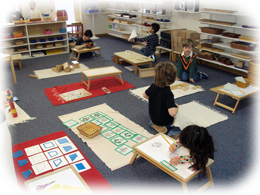
her ability will be at a maximum in future learning situation. The Montessori materials have this dual long-range purpose in addition to their
immediate purpose of giving specific information to the child.
Dr. Montessori always emphasized that
the hand is the chief teacher of the child. In order to learn there must be concentration, and the best way a
child can concentrate is by fixing his attention on some task he is performing with his hands. (The adult habit of doodling is a remnant of this practice.).
All the equipment in a Montessori classroom allows the child to reinforce his casual impressions by inviting him to use his hands for learning.
Over eighty years of experience have provided Dr. Montessori's theory that a
young child can learn to read, write and calculate in the same natural way that he learns to walk and talk. In Montessori classroom the equipment invites him to do this at his own
periods of interest and readiness.
Parents should understand that a Montessori school is neither a baby-sitting service nor a play school that prepares a child for traditional kindergarten. Rather, it is a unique cycle of
learning designed to take advantage of the child sensitive years between three and six, when she can absorb information from
an enriched environment. A child who acquires the basic skills of reading and arithmetic in this natural way has the advantage of beginning her education without drudgery,
boredom or discouragement. By pursuing her individual interest in a Montessori classroom, she gains an early enthusiasm for learning, which is the
key to her becoming a truly educated person.
The habits and skills which a child develops in a Montessori class are good for a lifetime. They will help him to work more efficiently,
to observe more carefully and to concentrate more effectively, no matter where he goes. If he is in a stimulating environment, whether at home or at school, his self-
education-- which is the only real education-- will continue.
